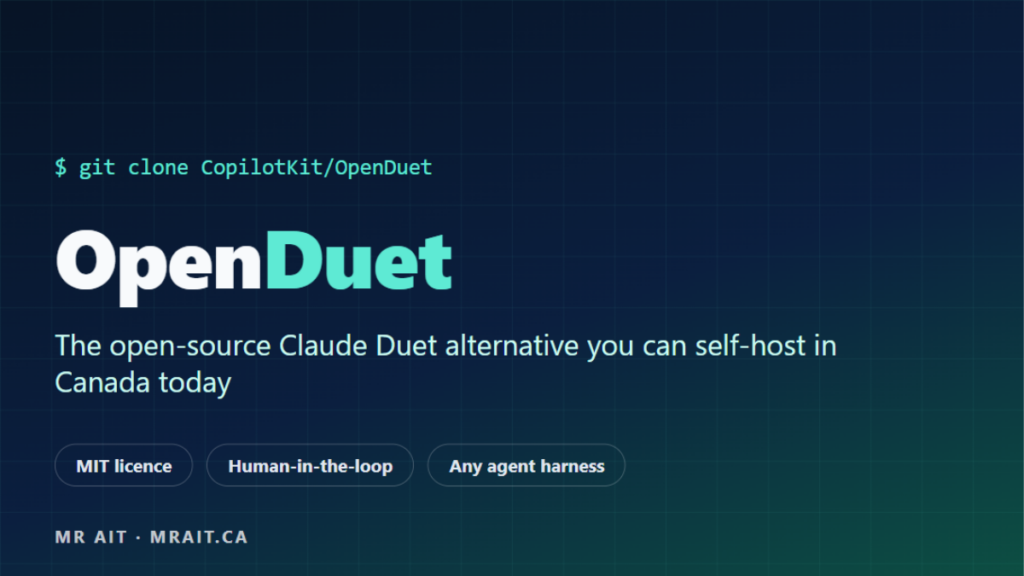
OpenDuet is the open-source answer to Anthropic’s Claude Duet: a self-hostable proactive AI agent from CopilotKit that messages you first, does work while you are away, and asks permission before it sends, pays, signs or deletes anything. It shipped on October 27, 2026 under the MIT licence, and here is the part that matters in Canada: Claude Duet is a US-only waitlist preview, so this is the version of the proactive-agent idea a Canadian can actually run today, on their own hardware, with their own keys.
Our team went through the OpenDuet repository and Anthropic’s announcement so you know exactly what each one is, what self-hosting really takes, and whether it is worth your weekend.
OpenDuet at a glance
Licence MIT, open source
Works with any AG-UI agent harness
Approvals human-in-the-loop, audited
Canada runs here today, no waitlist
What is Claude Duet, the original?
Claude Duet is Anthropic’s take on the next step past chatbots: a dedicated agent app that reaches out first. It sends you a morning brief on what needs your attention, monitors your connected workflows, automates tasks in the background, and comes back to you only when a decision is needed. It opened as a research preview on October 21, 2026, powered by Claude Opus 5.5, aimed at professionals and small businesses.
The catch for Canadians: access is a United States waitlist for Claude Pro and Max subscribers. There is no Canadian availability announced, and Anthropic has not said when the preview widens. You can join a waitlist from anywhere, but running it here is not possible yet.
What OpenDuet is
OpenDuet is CopilotKit’s open-source template that rebuilds the same proactive-agent category, which its own README describes as assistants that reach out first, such as Claude Duet. It is MIT licensed, runs on your own server, and connects to the agent harness of your choice. The feature set is surprisingly complete for a day-one release:
What running it actually takes
Open-source does not mean free of setup, and CopilotKit is honest about the stack: Docker and Bun to run it, a model API key, and a CopilotKit Intelligence project key (the free Developer plan covers it) for threads and memory. The default model is OpenAI’s gpt-5.6-terra, and Anthropic models are supported with a config change. Under the hood it is PostgreSQL with pgvector handling policies, approvals, audits and that encrypted credential store, and the whole stack comes up on localhost via a start script.
The genuinely interesting part is the agent-agnostic design: anything that speaks the AG-UI protocol plugs in, including LangGraph, Mastra, CrewAI, Pydantic AI and Google ADK agents, or something you wrote yourself. You are not adopting a walled garden; you are adopting a control room.
OpenDuet vs Claude Duet
| Claude Duet | OpenDuet | |
|---|---|---|
| Maker | Anthropic | CopilotKit (open source) |
| Status | Research preview, Oct 21, 2026 | Released Oct 27, 2026 |
| Canada access | US waitlist only | Self-host anywhere |
| Cost | Requires Claude Pro or Max | MIT free + your model/API costs |
| Model | Claude Opus 5.5 | Any AG-UI agent (gpt-5.6-terra default, Anthropic supported) |
| Where data lives | Anthropic cloud | Your server |
| Approvals and audit | Managed by Anthropic | Policy-checked, audited, self-owned |
Who should actually run OpenDuet
- Run it if you are a developer, freelancer or small business in Canada that wants a proactive agent now, is comfortable with Docker, and wants work data staying on infrastructure you control.
- Skip it if you want a polished one-click app: Claude Duet’s managed preview is that product, and the waitlist is the honest path, even if it currently excludes Canada.
- Wait a few weeks if you are curious but not urgent: a repo at 94 stars on day one will move fast, and the setup story will likely shrink.
This sits in the same wave as Google Genie 4 and the Gemini 4 Argon agents that beat Minecraft: the industry has moved from chat to agents that act, plan and ask permission. OpenDuet just hands the controls to you.
MIT licensed, self-hosted, works with any AG-UI agent harness
FAQ
CopilotKit’s open-source, self-hostable proactive AI agent: it briefs you each morning, works in the background and asks approval before taking sensitive actions.
Not yet. Claude Duet is a US waitlist research preview for Pro and Max subscribers, with no Canadian availability announced.
The MIT licence is free, but you supply a model API key and a CopilotKit Intelligence project key; the free Developer plan covers the latter.
Docker, Bun 1.3 or newer, a model API key, and the CopilotKit Intelligence key. One start script brings up the full stack locally.